




Chemical Manufacturing Companies in Singapore
Chemical Manufacturing Companies in Singapore: The Specialty Segment and Where Coraplus Fits
Singapore holds a large chemical manufacturing sector for a country of its size. Chemical manufacturing companies in Singapore range from the world’s largest petrochemical operators to focused specialty producers that supply regional industrial buyers. This guide explains how the sector is structured, names the main players, and shows where Coraplus Pte. Ltd fits as a Singapore-headquartered specialty chemical manufacturer.
Inside Singapore’s chemical manufacturing sector
Energy and chemicals is the second-largest sector in Singapore’s manufacturing economy. It accounts for around 3 percent of national GDP and roughly a quarter of total manufacturing. That concentration comes from decades of industrial policy rather than any natural resource. Singapore has no domestic oil or gas. Instead, it has location, infrastructure, and a regulatory environment built to attract long-term capital.
The sector runs in layers. Refining and petrochemicals sit at the base, turning imported feedstock into bulk products such as olefins and aromatics. Intermediate chemicals and polymers sit above that. The specialty chemicals segment sits at the top, where smaller volumes of higher-value products are formulated for specific industrial uses. Business directories list well over a thousand chemical manufacturing companies registered in the country, spread across all of these layers.
Feedstock reaches Singapore by sea, moves through the refining complexes, and passes down the chain to producers that convert it into finished chemical products. The country pairs this with one of the busiest container ports in the world, keeping import and export routes short for companies based there. Skilled labour, stable regulation and long-running government support have kept the sector competitive even as lower-cost production has grown elsewhere in Asia.
For an industrial buyer, the practical point is depth. A procurement team can source bulk commodity chemicals and highly specialised additives from within the same national supply chain, backed by that port and by suppliers that understand international quality expectations.
Jurong Island and the multinational majors
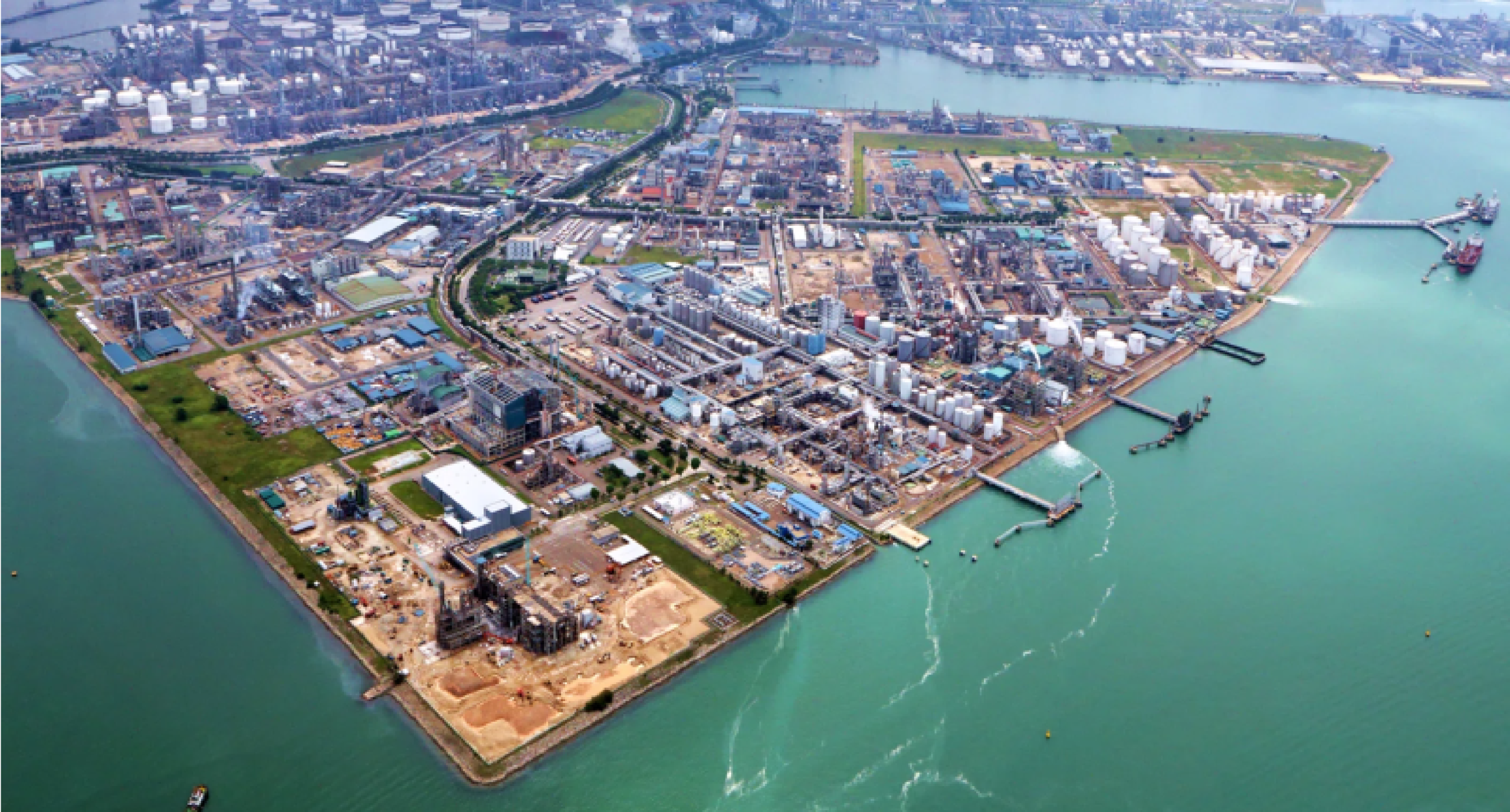
The sector’s cornerstone is Jurong Island, an integrated energy and chemicals park off the southwestern coast. Singapore created it by reclaiming land and joining several smaller islands into one site dedicated to energy and chemicals. It is one of the top integrated chemical parks anywhere and is home to more than 100 global companies. Over roughly three decades, it has drawn more than S$50 billion in investment.
The island works on a shared infrastructure model. Companies draw on common utilities, feedstock pipelines, storage, and logistics rather than building all of that alone. A product from one plant can feed straight into another as raw material, lowering costs and cutting transport. That design is a big reason so many chemical manufacturing companies in Singapore choose to sit on the island. It marked its 25-year milestone with a renewed focus on low-carbon, sustainable production, signaling where the sector is heading through the rest of the decade.
Global petrochemical majors anchor the island, running large integrated refining and petrochemical complexes that form the feedstock backbone the rest of the sector draws on. Alongside them, a roster of global chemical companies runs production and research sites in Singapore, covering a wide spread of applications, from construction and coatings chemistries to electronics materials and performance additives.
This cluster gives Singapore its reputation for quality, safety, and reliable supply. That reputation carries over to the smaller, more focused manufacturers operating from the same base.
The specialty chemicals segment, where the growth is
The majors provide scale, but momentum in Singapore’s chemical sector is shifting toward specialty chemicals. Since 2021, global companies have launched more than 30 new specialty chemicals projects across manufacturing and research, many on Jurong Island. Specialty chemicals are expected to grow faster than the sector overall, with a compound annual growth rate of around 4 to 5 percent forecast between 2025 and 2030, against 2.5 to 3.5 percent for chemicals as a whole.
The split between commodity and specialty chemicals matters, because it defines where a company like Coraplus operates. Commodity chemicals compete on price and volume. Specialty chemicals compete on performance. They are formulated to do a specific job in a specific application, whether that is protecting a polymer from oxidation, curing an epoxy system or improving the performance of a finished lubricant. The value sits in the formulation and the technical support behind it, not in raw tonnage.
The applications are easy to picture. A lubricant blender needs additive packages that hold up under heat and load. A coatings manufacturer needs epoxy systems that cure to the right hardness and finish. A plastics processor needs antioxidants that keep a polymer stable through moulding and through years of service. In each case, the buyer is paying for chemistry that performs to a specification, and for a supplier that can advise on how to use it.
This is the part of the market that rewards focus over scale. A specialty chemical manufacturer does not need the balance sheet of a petrochemical operator to compete. It needs deep application knowledge, consistent quality and the ability to supply the right product for a customer’s process. That is the segment Coraplus works in.
How Singapore regulates its chemical industry
Singapore’s standing as a chemical manufacturing base rests as much on governance as on infrastructure. The Economic Development Board leads investment and industry development. The Ministry of Trade and Industry sets the wider industrial policy direction. Enterprise Singapore supports standards and the growth of local companies. The National Environment Agency oversees pollution control and the handling of hazardous substances.
The Singapore Chemical Industry Council, known as SCIC, is the private-sector association for the energy and chemicals cluster. It has a membership network of more than 170 companies spanning multinational corporations and small and medium enterprises across the whole supply chain. SCIC is the national administrator of the Responsible Care programme in Singapore, the global chemical industry initiative for continuous improvement in health, safety and environmental performance, and it manages standards development work appointed by Enterprise Singapore.
For companies that manufacture and handle chemicals, these rules set clear expectations on safety, storage, transport and emissions. Compliance is not optional, and buyers know it. Quality management standards such as ISO 9001 sit alongside the national framework and give customers a further check on how a supplier runs its operations.
For a buyer, this regulatory depth is a form of assurance. Sourcing from chemical manufacturing companies in Singapore means sourcing from a market where safety, environmental and quality standards are actively maintained and where the industry helps set them. That lowers supply risk in a way that is hard to match in less mature markets.
Where Coraplus fits in Singapore’s chemical manufacturing
Coraplus Pte. Ltd is a Singapore-based specialty chemicals company headquartered at 12 Marina Boulevard, #17-82, Marina Bay Financial Centre, Singapore. It sits in the specialty chemicals segment, where the advantage comes from application focus and technical depth rather than scale. Coraplus holds ISO 9001:2015 certification for its quality management system.
Coraplus works as a formulator and supplier. We develop and supply specialty chemical products for industrial customers, drawing on in-house formulation and a selected supply base to meet the specifications a buyer sets. The model is built around getting the right product to the customer and supporting its use, rather than around volume output.
What sets Coraplus apart from many specialty producers is our structure. Most specialty companies organise around a single product line and build their identity around that one chemistry. Coraplus takes a different approach. We operate through a family of brands, each dedicated to a specific application, all under one Singapore parent. This gives industrial buyers a coordinated portfolio across several chemistries, backed by one company’s standards and one company’s service.
The advantage we offer is not size. It is the combination of a genuine Singapore manufacturing base, a focused specialty portfolio and the reliability that comes with operating inside Singapore’s regulatory and quality environment.
How the Coraplus brands work together
The brand structure is the clearest expression of how Coraplus works. Rather than stretching one brand across unrelated applications, we run distinct brands that each own their space.
LUBIMAX™ covers lubricant additives, the performance chemistries that go into finished lubricants and greases for automotive and industrial use. EPOCURE™ covers epoxy systems used in coatings, adhesives and composites. XONOX™ covers polymer antioxidants, which protect plastics and polymers from thermal and oxidative degradation and extend product. CARBIMAX™ covers carbon black that is widely used for industrial rubber, tires, plastic, textile, toners, and printing inks. MAXXPOL™ covers plastic and rubber additives that improve processing and end-product performance across the plastics and rubber industries.
Each brand carries its own application expertise, and together they give a buyer access to a broad set of specialty chemistries through a single supplier relationship. The benefit to a procurement team is consolidation without compromise. A manufacturer that needs a lubricant additive, an antioxidant and a plastic additive can source all three from within the Coraplus and work with one company’s technical and commercial standards throughout.
Each product still comes from a brand built around that application, so the buyer does not trade specialisation for convenience. This structural choice is what sets Coraplus apart from single-line specialty companies, and it does so without any need to compare Coraplus against other named firms.
Serving ASEAN from a Singapore base
Singapore’s value as a chemical base is not limited to what it produces. Its position as a regional gateway matters just as much. The country sits at the centre of Southeast Asia’s trade routes and works as a hub for research, production and regional headquarters in the specialty chemicals sector. Its location, infrastructure and chemical parks make it a natural distribution point into the wider region.
That regional context matters, because ASEAN is one of the fastest growing chemical markets in the world. The Southeast Asia specialty chemicals market was valued at around 47 billion US dollars in 2024 and is forecast to reach roughly 84 billion by 2034, a compound annual growth rate of about 6 percent. Demand is rising across construction, automotive, electronics and textiles, all sectors that use the chemistries Coraplus supplies.
For a buyer in the region, a Singapore supplier offers a practical mix. Manufacturing and quality sit in a market known for its standards, while the supplier stays close enough to serve regional demand without the delays of long-distance sourcing. As factories across Southeast Asia expand, the pull is towards suppliers that can hold quality and stay near the customer, and a Singapore base supports both.
Operating from Singapore gives Coraplus Pte. Ltd. that advantage. For industrial buyers across ASEAN, sourcing from a Singapore-headquartered specialty chemical manufacturer combines regional reach with the assurance of Singapore standards. That is the position Coraplus holds, a focused specialty chemicals company structured around a set of application-specific brands, working from one of the most respected chemical manufacturing bases in Asia.